Saturday, 23 August 2014


An affair to no END.

Anirban Mitra.
Calcutta, Sunday 24th of August.


“Time stays long enough for anyone who will use it” – Leonardo Da Vinci.
A fine, mechanical wrist watch is probably one of the most beloved possessions of man – something very ‘human’…as it runs when you wind it or by the movement of your wrist. It is so very personal and attached to us…just like a pet. It is not independent like a battery driven machine…and hence we tend to develop a special bond with it. We know it is dependant on us J
Imagine, a small, coiled spring which could unwind itself in few seconds does so in 36 hours by the aid of complex engineering! In the history of time keeping - from sundials to tourbillon, so many illustrious brands have graced this supreme and timeless invention of mankind – our time keepers: The clocks and watches.
For me, and I am sure for many, one particular brand remains very special in that journey.
WEST END WATCH CO. Swiss made. Since 1886.
With India, the bond is historic. From Her Majesty’s troups to civilians, it graced generations...
In the recent times, remember Kareena Kapoor’s old wristwatch in the film '3 idiots'?
It was a West End Watch: a true classic and one of the best of Swiss horology.
I am sure, for many of us, there's a West End we possess or at least we know of there is. Don’t we?
I fondly recollect the joy of getting to see for the first time - my Grandfather's gold cased, full hunting, West End ‘Competition’ pocket watch. It was a high-end model of that era. The watch was taken out of the bank locker nearly half a century after his demise. The bold, Roman letters on the superb, enamelled, sub second dial looked riveting and the watch – regal. In the red velvet case, it seemed to be a pearl in the shell.
The expert technician delved into the watch with his eye glass. It was a 23rd January – Indian National Holiday on account of Netaji’s Birthday. The service centre was opened, by appointment, exclusively to attend my Grandfather’s watch so that the work could be done uninterrupted, in quietness and peace. I sat anxiously as the adventure unfolded…
“This watch was last serviced in 1954, right?”  I was taken aback by the unexpected deduction.
“Yes, probably, it was the last time before my Grandfather died in 1958.
I heard my father told me the watch used to be maintained by the famed Abrecht & Co. of British India, but how did you infer?”
What Holmes would have termed ‘elementary’, came from the technician as:
“Hmm. In almost microscopic size font, they have inscribed the date on the case inside back.”
The comprehensive servicing was completed at 9:30 p.m in a neat 4 hours job.
I remained a patient and amazed spectator waiting to see the long awaited continuity of the past in the present.
And finally that wonderful rhythm started to play: tick tock, tick tock… The old, gold watch looked and worked like a showroom piece.
Handsome beyond compare, pristine, spotless and with an attached gold chain, it came as a gift for the bridegroom from my Grand Mom’s home! 
The recollection makes me excited, whenever I think of the episode -the unmatched joy of seeing the watch ticking (after 50 years of rest). It was a moment of truth and a sense of great contentment for me to place the newly serviced watch before my father. It was a rejuvenation of fond memories of profound association.
It is about such joy of restoring and preserving these treasured heirlooms. Of hunting and procuring NOS (new old stock) models which erratically (and rarely) pop up from old shop attics ; and then getting the right wrist straps befitting these old world models!
One day, one of my friend (a fellow watch aficionado) told me:
Anirban, great news, that shop, I found has got a stock of vintage, but unused West End Watches! 1950s Sowar Prima. Daisy fresh. I got one for myself …people are picking in 2s and 3s…rush, rush !”
Oh, what a discovery!!
And there are so many other lovely memories and trivia - that’s the essence of the relationship with this great brand.  Each West End Watch that I had inherited or have bought has some special story and adventure around it. No wonder, cause the brand epitomises strength and adventure!
Great watches, great moments, great memories…
The love affair with West End has no end!!

***
Some of the past /present models of West End Watch Co. are listed, below.
(You can check their lovely website and Facebook page.)

Queen Anne, Sowar / Sowar Prima, Secundus, Keepsake, Sillidar, Philos, Bijou, Competition, Matchless.

And the relatively lesser known:

Imperator, Aftab, Dost, Index, Themis, Mohka Prima, Genteel, Campaign.
 
*** 


The name of “Queen Anne” was given to this wristwatch in homage to the last queen of England and Ireland of the Stuart dynasty, whose reign, from1702 to 1714, was marked by the ascendancy of the British navy over the oceans of the world and by the birth of the United Kingdom through the union of Scotland with England and Ireland.
This watch proved itself worthy of its name, so dear to the British, by its exceptional qualities of reliability and resistance to all the trials of everyday life - like Queen Anne herself.

  
Queen Anne vintage Trench Watch.


At the beginning of the 20th century, a model was launched, called the Sowar — the cavalryman —
a tough watch that could be kept in the pocket or worn on the wrist.

It soon came to the attention of the military, and in World War I, tens of thousands of Indian soldiers bought Sowar watches before leaving on campaign.
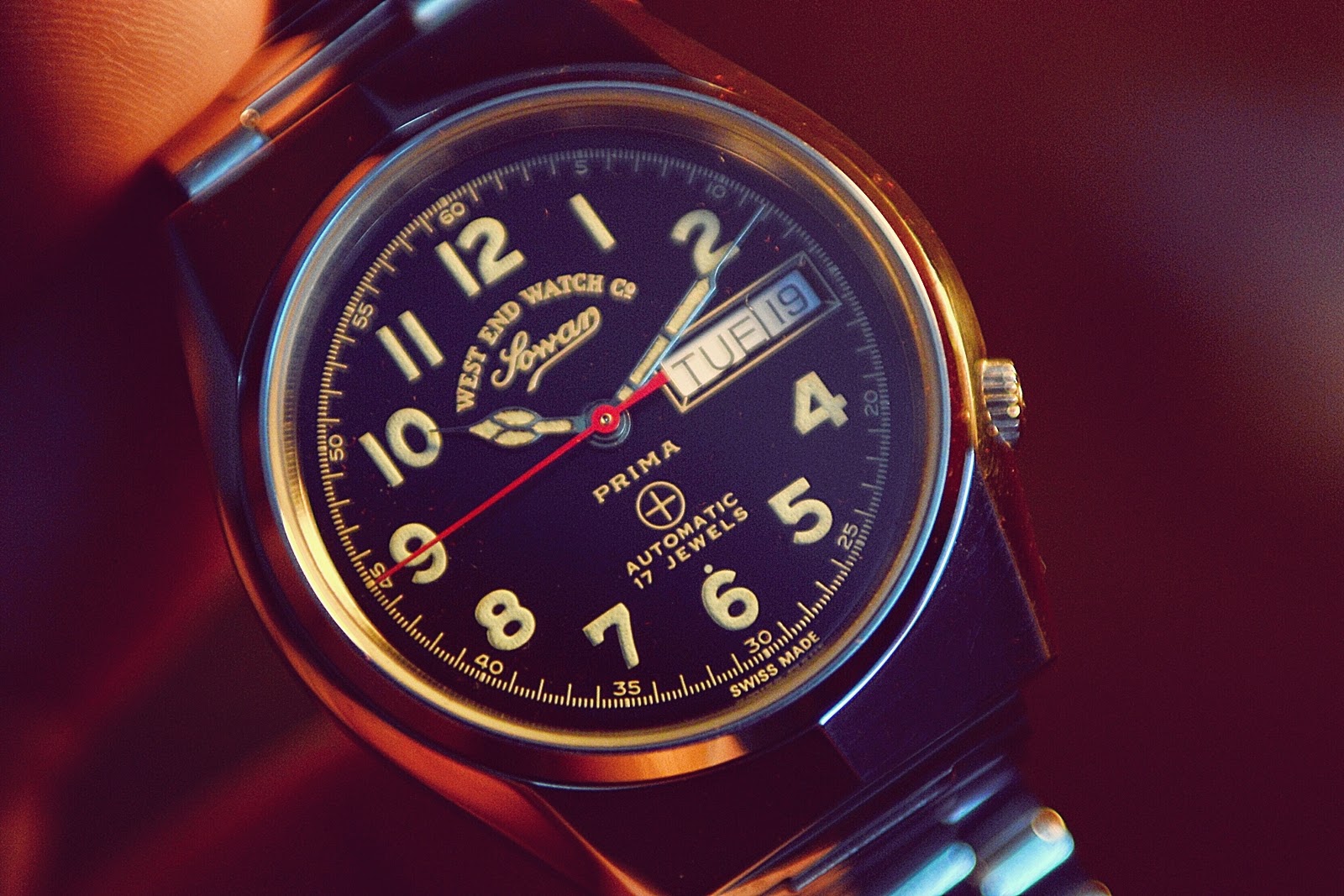

By 1934 the Sowar was a modern wristwatch, the first with the Incabloc™ anti-shock system.
Today, after more than a century, the model follows the same concept — robust, clear and functional —
with a trustworthy feel and look.


Silver Trench Watch with enamelled dial, circa 1930.


In India, West End watches proved their excellence in their use from the end of the 19th century by all the staff of the main railway companies, the post and telegraph offices, the police, the ports and the Indian and British government administrative services.


The West End Watch Co. in Dalhousie Square, Calcutta.
From a postcard published by Thacker, Spink & Co.
Photograph by Johnston and Hoffmann, circa 1908.




Thursday, 21 August 2014


The Great Eastern Waterloo

Anirban Mitra.
Calcutta, Friday 22nd of August.


“To know nothing of what happened before you were born is to forever remain a child” – Cicero.

Not only did Napoleon Bonaparte defeated in the battle of Waterloo, but the name of Waterloo was as well. Well, the latter not in the United Kingdom of Netherlands, but nearer to our place, nearer to our times - off Old Court House Street at Calcutta.

Whenever I visit this part of the city, the footage of nostalgia tends to engulf me and I am almost, always taken into a time journey of sights and sounds of history playing like in a movie theatre. I do not recollect my past lives, no I do not, but with the memories of those wonderful, life-like photographs by Bourne & Shepherd, Johnston & Hoffmann and other studios of British Calcutta and complimented with a flight of imagination and observation, it is not too difficult to visualise the charming Old Calcutta in the decaying new.

In the silence of the taxi strike and calmness of the evening largely devoid of traffic sound and of humidity (result of the recent downpours) -walking back from Dalhousie Square to Esplanade was my preferred mode of transit. Well, almost. Tired, quite, and with my too formal, pointed boots (which could compete with Mr. Hercule Poirot’s) not particularly suitable for long walks, I still chose to walk. The trams had retired for the day a while back and I could not catch the last one near the bend at the St. Andrew’s Kirk. I had just deposited one of my West End Watch wrist watches at The Anglo Swiss Shop. The Calcutta establishment of West End Watch Company was here somewhere near by Stephen House, as also their illustrious contemporary – James Murray Clocks. The forward view with the majestic, Central Telegraph Office at North East past ‘Laldighi’ and the regal Currency Office porch on left - this is one of THE few walks Calcutta could still offer to reveal its English past. And how could I resist?

Good Lord! What an area it was and partly still is!! A lovely water body of Laldighi in center and grand edifices all round with gracious roads in between ; Government House, Writer’s Building, Church, Offices, Shops and Establishments, Hotel, Park of Lord Curzon…  Superb town planning and the quintessence of Imperial Calcutta personified.

I had just finished a bottle of refreshing Ice Cream Soda and was brimming with new energy to begin a new walk. The bottle proclaimed ‘Cotton’s, 1906’.  They seem to be preparing the drink since Curzon’s days!

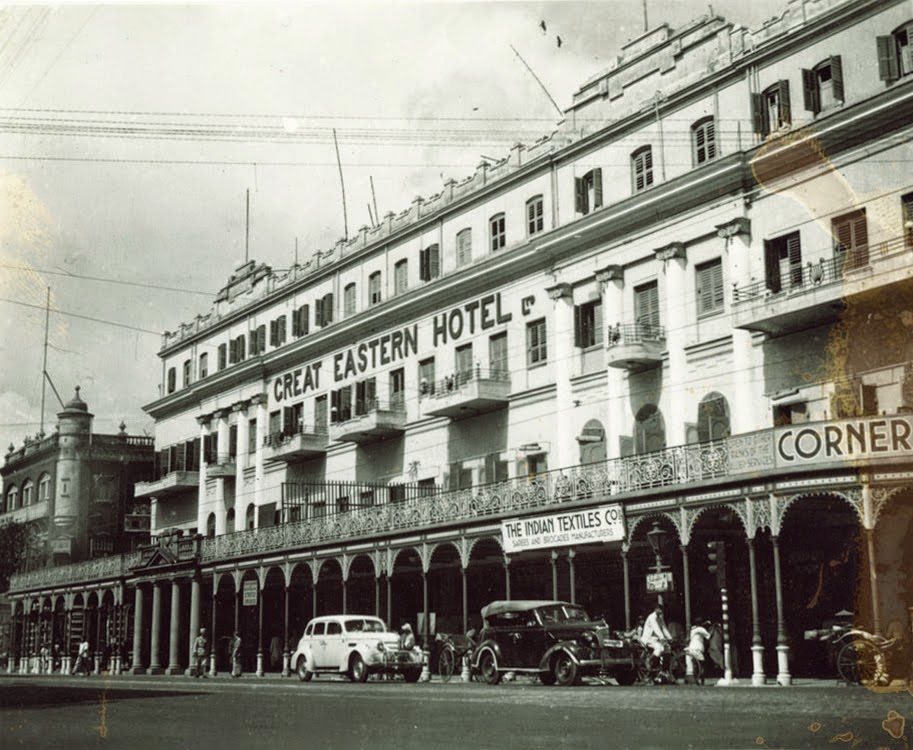
After the traffic crossing while I took the left footpath, the last few customers were having roadside tea and biscuits as the magazine vendors and other hawkers started to fold their establishments – well, only for the day. Many of them had crossed the borders from further East and found a safe home in this city and convenient ground for retail business on the footpath. The benevolent government found new supporters in them, so every wrong was all right. Not so many years earlier, there would be those series of renowned English establishments along this road – F.W Baker, Hamilton & Co, Harry Clark, Ranken & Co and of course W. Newman and J. Boseck on the ground floor of the great Great Eastern Hotel.

Tea was not served on the footpath, then, cheap Chinese toys not sold, but Opium was exported to them and they sold us Tea – which we had in a more elegant and elaborate way than on the footpath.

Even till a few years back (seems to me like only yesterday), I used to see Newman’s selling odd books and stationeries. And the old world, embossed signboard of J. Boseck reminding of the glory gone by – of Swiss Watches. Rolex, Omega, Tudor, Tissot and the likes.

In front of the huge mahogany doors would be the guard of Great Eastern Hotel in full regalia ...with a world of pristine charm and grandeur welcoming you inside. Of much more than 5-Star luxury. Even a fortunate glimpse-in would be a refreshing view for me as a young boy. The view opposite, now occupied by a electronic retail shop who borrowed its name from the Hotel reminds of the erstwhile building of Cooke & Kelvey – Silversmith, Jeweller and Watch makers of unparallel repute in the undivided East. Their chain-fusee wall clock, circa 1890 shows me time in my room and reminds me of another era.

It is the narrow lane adjacent to Great Eastern Hotel that was once called the Waterloo Street.

I remember the bakery counter of Great Eastern on this street where the finest of patty, bun and other delicacies could be had, and there would be a long queue during Christmas.

A letter to the editor of the Government Gazette, dated January 17, 1828, states : “The Road recently constructed through Dacre’s Lane, called Waterloo Street, has greatly added both to the beauty of the Government House, by opening its prospect, and to the convenience of the community, by affording a direct and speedy communication to the Cossitolla Street (the modern Bentinck Street)…”

And who knew that a few decades from then, the street will be stripped of its name and history, to be renamed as ‘Nawab Siraj Ud Daulah Sarani’? And what for?? I feel sorry for the defeated Nawab, but it will not entirely be devil’s advocacy in saying that the treachery of Mir Jafar, his minister led to the birth of once lovely and great city of Calcutta from a group of few swampy, mosquito laden villages along side the river. So much so, that it was termed as the ‘Second city of the Empire’, second only to London. The City of Palaces. Mr. Charnock did us a great favour. May his soul rest in peace.

The historic receptivity and artistic sensitivity of the civic authorities are so commendable that they have chosen to reinstate the older past, even in a street name, but allowed the demolition of the GREAT, heritage hotel just adjacent to it. The façade of Great Eastern Hotel had partly been retained like a cardboard contraption and is a cruel joke. The entire building has almost completely been demolished and a new, arrogant block of concrete gleams in mockery as one walks by Waterloo Street…sorry, Nawab Siraj Ud Daulah Sarani. At the other end of the road, you will still get the Nawab’s Biryani, but not those cakes and patty you left past, and whose fragrance brings sweet and melancholy reminiscence to many nostalgic minds.

In the present times, the stretch of walk in front of the Hotel is barred for the public ; the front view is shocking like an aftermath of devastation. Ahoy, work in progress! - the renovation of the new façade has not been completed unlike the speedy commissioning of the business of business on its modern backyard.


A vintage label of the hotel in all her glory.


 Photograph circa late 1940s.


 A view from, probably, atop the Great Eastern Hotel


Photograph by Bourne & Shepherd, circa 1870s


Sunday, 1 June 2014

Let there be light

Anirban Mitra.
Calcutta, Sunday 1st of June 2014.


“In the fields of observation chance favours only the prepared mind” -Louis Pasteur.
During the shooting of my narrative on the Stately Homes and Palaces of Calcutta, on my keen interest to details, in admiring and being receptive to the elegance of many remnants of the bygone era, I remember being shown vintage light bulbs on the antique lamp shades that graced the living rooms of the noteworthy Bengali household. Robertson of England – if I recollect rightly and of course Philips of Holland. In the Mullick mansions and other palaces, the owners proudly proclaimed that these bulbs have continued to remain alight from the time of their installation in the 1920s and 30s when electricity came into these elite homes in Calcutta. I was awe struck by the sheer quality of these products. The old designs commanded respect and bore testimony to a great invention of mankind.
And unlike the blinding white, modern fluorescents, the predecessors - these tungsten bulbs had a nice, creamy tone in the light and always added a 'character' to the setting where they belong.

At the Murshidabad Palace – Hazarduari, there were these bulbs too…probably even older…lovely, small ones with exquisite filaments fitted on the majestic, period chandeliers. On asking the caretaker – I was confirmed they are from the British times and continue to light up since close to a century!
A different scene from today, when we procure bulbs almost as a regular ration and they go off quite too often - much to the dismay of having to replace frequently. Obsolescence and degradation must be promoted, else how will the business survive? Well, that’s fodder for another story – not that I am keen to discuss on that. Rather, I am not.
Getting to see the vintage bulbs in Stately Homes and Palaces, along with antiques and things of value is not too uncommon, though their sheer timeless appeal supersedes the logic of their being. What is, however most amazing is the presence of the past in the most unassuming of the present times and in the most banal setting.
Many of my Saturdays are spent in Radhabazar – watch paradise of Calcutta, in getting my mechanical wrist watches serviced and in enquiry for probable ‘new vintage’ supplies to add to my modest collection!
Every corner, every shop, the alleys, twists and turns are too familar to me. Every sight and sound - from the car horn to the clock ticking ; The cart-wallah selling delicious, hot pakoras, the tea vendors, the man with his small packets of red peanuts and fried green peas and even the unkempt bathroom in one of the narrow lanes – which is a misfit to the fun of spending time in a great setting of clocks and watches.
You must be wondering, in all these recollections of things vintage and of grace, where do a bathroom in a narrow alley of Radhabazar really fit in?
Well, hold on, this is the place where, just a week back I spotted an odd looking, but a fine, period bulb akin to the ones adorning the aristocratic lamp shades and light fixtures of great homes.
Curious, as I am to old things, and true to my style, the adrenalin starts to flow by the whiff of any new discovery of a long lost piece of art or technology.
My blood was up and I stepped inside again – inside the lavatory, to introspect upon my suspicion!
Ah!! ‘PHILIPS. Made in Holland’ – the yellowish bulb with a low, mellow light truly lived up to its embodiment – a lovely, vintage piece, with a fantastic, ornate filament and with proud, aglow!
I started to interrogate the man with the watch buffing machine stall opposite to the lavatory:
“Umm…you see…that bulb…I mean the one in the lavatory…that seems to be an odd piece, isn’t it ?”
“Yes, it is’ – the man, with whom I share a good rapport, smiled.
“And where on earth has it popped up from?” – I was greedy and overly inquisitive.
“Oh, that shop, in that lane” - he directed me. “They were clearing up the mess and got a big box full of old bulbs, which they distributed as freebies. Many of us picked up and one was put up there, which you can see”.
In the next few minutes, I rushed to that shop.
It was as mundane as can be, shorn of any signs of the bygone era and with no traces of any thing remotely interesting. Quite simple and modern, devoid of any individuality whatsoever.
“That bulb…” – I tried to make an introduction to the shopkeeper and start a conversation with a suitable context.
He looked at me trying to probably place me in perspective with respect to my motive. Clearly, he made out - I was not in for the business he offers.
“I mean that bulb, there up on the lavatory” – I continued. “I just heard you supplied that one. Quite interesting…”  I was still at a loss of a coherent dialogue. “Do you have more?”
The man looked at me in wonderment.
“I have great fondness for old stuff and was hoping to get a few…I mean buy them if they are still available”.
“Oh…is it? Let me check” – and he stepped down from his shop to help me in my little adventure, but only to return a few minutes back, disappointed.
“I am so sorry. I had a carton full of them, you know. I gave it away to that shop. They’ve, I heard, kept the imported, vintage pieces for themselves – the likes of which you fancied…and distributed the desi ones to the others. They will not return back those bulbs, even for money. I enquired”.

Oh.

I was almost planning to visit an antique shop to get a suitable table lamp to adorn the befitting bulb, and found out that my hope was a bit too far-fetched.
Old seems to be nothing less than gold ...and people, even in this fast changing, modern times, do not miss to pick up 'obsolete', odd pieces. And lovingly so, to the extent of being immediately possessive and not ready to part with them for any lure.
 

Details of the filament of a Holland Philips vintage bulb.

 'Bengal Lamp' bulb.


Sunday, 27 April 2014


Those cakes in the trunk.

Anirban Mitra.
Calcutta, Saturday 26th April 2014.


The narrow lane off Wellesley Road towards the Wellington side which was called the Turnbull Lane, and till 1935 as Turner Street is now known as Nawab Abdur Rahman Street. The mongrel potpourri of Wellesley carries in itself the whole romance of the splendid decaying charm of Calcutta. It is this place, near Ripon Lane where I remember spotting a licensed shop selling opium, fondly recollect an Anglo Indian home where I picked up a HMV box gramophone (model 113) – the owner with his brilliant blue eyes and a lovable puppy and discovered a dry cleaner on a corner where the tram lines bend - proclaiming something akin to ‘I live to die. I dye to live’. 
 

There is nothing remarkable about the narrow alley of Nawab Abdur Rahman Street, except that it leads to the Saldanha’s.

On both sides, as you walk, you would find the series of those gracious, old houses with crumbling façade, discoloured signboards and a layer of poverty stricken neglect that is so sadly typical of this area of Calcutta, well, like so many other. As I looked around for that particular billboard and was about to ask for assistance that I saw a beggar sitting for alms, far from the luxury of warm bakery produce. With some shock, a sense of subtle guilt, but more with an air of overlook and enthusiasm I surged ahead to spot the name prominently inscribed in big bold letters on the German-buff coloured wall leading to a house.

It was relatively much cleaner and well kept than its neighboring houses and although an old house, the modern additions and a couple of parked sedans sort of testified the old enterprise doing brisk business in the present times. I felt happy to see the continuity. As I moved forward past a big hall on my right where workers were arranging for a cake-mixing in a giant tub, a welcoming, winding staircase revealed itself.


Denzil Saldanha’s enterprise is baking delicacies since the 1930s in Calcutta and is easily one of the few surviving family run businesses that command respect and a decent following in spite of zilch advertising of any kind. M X D Gama, another Goanese bakery closed down a few year back and I still remember the lingering taste of their cakes and pastry brought home by my father from Sir Stuart Hogg’s evergreen, old New Market on his way back from office.

The likes of these authentic bakeries are not abundant in the modern times where many flashy, air conditioned showrooms, steep prices, coupled with arrogance and over hyped existence largely serve subpar and insignificant produce, except for freakish exceptions, that are hard to find or afford.

I ascended up the staircase and entered into the house that can best be summed up in one word as cluttered. Given a second choice, I would say – chaotic.

‘I have had not placed any orders, but do you have anything to offer at this point? – I enquired with a lady whom I discovered later as being the domestic help. ‘Please take a seat’ – I was shown a comfortable sofa with velvet upholstery, following by her calling someone inside mistakenly stating ‘the customer’ has come to pick up the delivery. I corrected that I was not ‘the customer’ but certainly is one of the similar breed.

The room looked familiar to me as I had seen many of such high ceiling, elegant old Calcutta homes that tend to immediately take one to a time journey from the pigmied present to the gracious past. The table and the floors were stacked with white card board boxes and there was a huge, tin trunk which I half guessed to be full of fresh produce! Lovely Easter Eggs, cakes, bottles of vanilla, essence, chocolate powder, cans of flour and a aroma of fresh bake make you feel at home with the Saldanha’s and an assurance that you are in for big time gastronomic indulgence.

A lady came in and greeted me with a lovely smile. I declared again I am not ‘the customer’ she might be expecting and that it is completely an unsolicited visit of me without a pre-order, hoping to pick up whatever is available, if any. A little preamble and prelude also established my acquaintance and introduction with Saldanha’s through the delicious, spongy Lemon drop cake that I enjoyed at the Loreto House along with the crispy cheese sticks andcoffee – all of which were distinctly different and remarkably classy.
‘We are all Loreto educated’ - she smiled. ‘Our business runs by goodwill and by the word of mouth’ – she continued. ‘In the old times the salesmen would carry the cakes in black trunks sporting the word ‘Saldanha’s’ and they would be home delivered’.

As I chose to pick up the Lemon Drops, a pound of walnut cake and the cheese sticks, the lady insisted I also try the Brownies. ‘It is not too sweet and very soft inside. We make it with imported dark chocolate’ – she advertised. ‘The Easter eggs you see are being packed for orders from the United Kingdom and Australia’.

‘Would you like these Almond Slices?…few left…they have been made to order and are not regular produce’.

As I returned back to my car, contented with the success of the discovery and the reassuring taste of the deliciously soft and creamy lemon drop on the way, I impulsively stashed the empty box of it in a pile of garbage on the street – so very unlikely of me with civic sense. Did anyone see me – I wondered in embarrassment.

The old man was still sitting there. I was almost sure he had not been fortunate to have a single benevolent passer-by all these while when I was romancing with excess in choosing my pick of the bakery delights for snacks, dinner and breakfast.

I hope there will be another chance for me to introduce him to the taste of Saldanha’s.


Freshly baked Walnut Cake.
Soft. moist, delicious and the perfect companion for tea or coffee.


Brownies, Lemon Drops, Almond Slice & Walnut Cake.


Enjoy!


Thursday, 29 August 2013


Darjeeling, here I come to you.

A mini, photo travelogue in the troubled times.
by
Anirban Mitra.


I had been planning a long weekend at Darjeeling, my all-time favourite repose destination, more for a vacation than anything else.

I went there as a kid, as a grown up…and in spirit and essence, every time while watching Satyajit Ray’s film : ‘Kanchenjungha’!
And BBC's wonderfully warm film on the Darjeeling Himalayan Railways rejuvenates the lovely memories of the place.
As a small boy, I remember my father buying me from the Mall - a superb, velvety, grey color cap  and delicious milk chocolates from Graham’s Home at Kalimpong - the sweetness of which has remained with me. When I grew up, I felt Darjeeling with a matured sense of appreciation -enchanting as ever, with the old charm still alive amidst all indiscretions of politics and power.

Then of course, the political scenario warmed up with the local leaders demanding an independent state and a separation from Bengal. With a declared temporary respite of the agitation during the 15th August weekend to celebrate India's independence, there was a hope for a clear, peaceful 4 days and I decided to take a chance.
Although recently in the spotlight for not really the right reasons, the charm of Darjeeling as a hill station, yet another British creation in India, has never ceased to enthrall its many visitors, even in compromised times.

The place was first conceived as a sanatorium for the soldiers during the British Raj owing to its temperate climate, attracting British residents seeking to escape the summer heat of the plains. Since the days of the Raj, Darjeeling developed briskly with the first road connecting the town with the plains being constructed between 1839 and 1842. It subsequently went on to become the most significant, commercial cultivation spot of tea and induced a number of British planters to settle there. The place also had the distinction of being the formal summer capital of the Bengal Presidency. Scottish missionaries undertook the construction of schools and welfare centers that are of considerable repute even to this date with students around the globe. The Darjeeling Himalayan Railway is one of the loveliest hill railways in the world and it still operates on the narrow gauge whistling through the twist and turns of the mountains.
Dotted with the many imprints of the Raj and with a pristine English charm, Darjeeling attracts foreign and local tourist alike, in thousands, throughout the year.

My decision to go ahead with the vacation, which at first appeared to be a rather risky undertaking, with media updates every now and then on the resuming of the tension at the hills, ultimately turned out to be one of my most pleasant tours and certainly my best stay at Darjeeling so far.

After a long spell of closure, the relaxation triggered a fresh lease of life and activity at the hill. The vehicular traffic started to ply, the shop shutters went up and the restaurants offered nearly whole of their delicious repertoire. Well, almost.
Breakfast, lunch and dinner at Glenary’s – the view of the hills, the afternoon at the Keventer’s CafĂ© staring at the Chowrasta and longing for a glimpse of Kanchenjungha to appear from within the clouds, those ham toast sandwiches, sausages, puffs, muffins, pastries and the aromatic tea perfectly complimented the long, undisturbed walk down and up the winding roads, the shopping of Tibetan bric-a-brac and a leisurely stroll at the Mall staring at the handsome ponies and the people.  Children with red cheeks.

The long queue at the ATM counters testified the brewing abnormality of the apparently peaceful break pregnant with the possibility of new unrest, threatening to reappear any moment. Many businessmen and affluent people had left for the plains for a forced vacation, but it were the local people who stayed and suffered the most. The hotels offered rooms at half the normal rate and even less, the waiters at the food joints brimmed with joy over small tips; the crowd looked melancholy and depressed. The flock of students resuming schools and the smile of their moms cheered up the scene a little. The fluctuating weather of rain, shine and cloud seemed to echo the mood of the times.

Armed with a pocket camera, taking a break from my heavy SLR and other obligations at the heat and dust of the Calcutta plain, I soaked in Darjeeling and clicked away, in love with the place.


Enclosed are the vignettes of my impression of this very special visit.


Chiaroscuro of Darjeeling Sky


A remarkably calm afternoon at the Mall.


The famed Glenary's of Darjeeling:
serving Bakery products, Continental, Indian and Chinese delicacies.


A family lunch at the Glenary's

Fried Fish and Chips @ Glenary's.
Cheese Pasta with Beacon added, made a lunch :-)

A tourist takes notes during morning tea at the Glenary's
 
Glenary's Club Sandwich. Cooked ecstasy.


A Technicolor view of Darjeeling

The Mist

Gathering of local people at the Mall

Students in Mist

A scene at the Mall

View of Kanchenjungha from Keventer's Cafe

Ladies appreciating archived photographs at a Studio

Portrait of a young man

Traversing the winding road up and down the Mall

Keventer's Cafe -the essence of nostalgia.

A street scene


Your's truly at the steam locomotive Yard.
On the sides are 'Himalayan Bird' and 'Queen of the Hills' - made in Glasglow, England, a hundred year back.
Photograph courtesy, my sister : Kamalika Mitra.

A view of the hills at dusk.

The Victorian fountain during night. The Mall.


Panaromic view from Darjeeling Railway Station.

The picture of silence.
Returning from Darjeeling to Bagdogra airport.

---


(Anirban has a multitude of  interests and fields of work :-) but his writings are as casual as this one, and his passions -plenty and abound. This blog will try to accommodate the expressions of some of those eccentricities!
The images (c) presented here are just casual snapshots of the traveller in him and not of a photographer per se.)